For law firms and solicitors
AI answering service for UK law firms
New client enquiries, answered while you're in court. Maeby captures the matter, the parties, and how urgent it is, books the initial consultation, and never gives legal advice.
UK & EU data residency · No call recordings
- Answered on the first ring, including evenings and weekends
- Every callAnswered on the first ring, including evenings and weekends
- Legal advice given; anything that needs a solicitor goes to a solicitor
- ZeroLegal advice given; anything that needs a solicitor goes to a solicitor
- Client call data processed and stored in Ireland
- EU onlyClient call data processed and stored in Ireland
Where the phone costs you money
New matters arrive while everyone is billing
A prospective client rings when they have a problem, not when reception is free. In a small firm the person who could answer is with a client, on the phone to the other side, or in court, and the call rings out.
- Callers with a new matter work down a list and instruct whoever answers first
- Reception is thin at exactly the times fee-earners can't be interrupted
- A missed call leaves no record of what was lost, only that the phone rang

What gets captured depends on who picked up
One person takes a name and number. Another takes the whole story. The solicitor calling back has no idea which, and the conflict check can't start until someone has the names of the other parties.
- Callbacks made with half the information, then a second call to get the rest
- Other-party names missing, so the conflict check waits for the callback
- No consistent record of how the caller found the firm
Out-of-hours callers are often the urgent ones
Someone arrested on a Friday evening, a notice served with a deadline, a family emergency. These calls land on voicemail alongside the routine ones, and Monday starts with sorting rather than acting.
- Urgent and routine calls look identical in a voicemail inbox
- Most callers with a serious problem don't leave a message; they ring the next firm
- No way to route a genuine emergency to the duty solicitor

What your agent handles
Tools are switched on per agent and configured with your details — no bespoke development.
Structured client intake
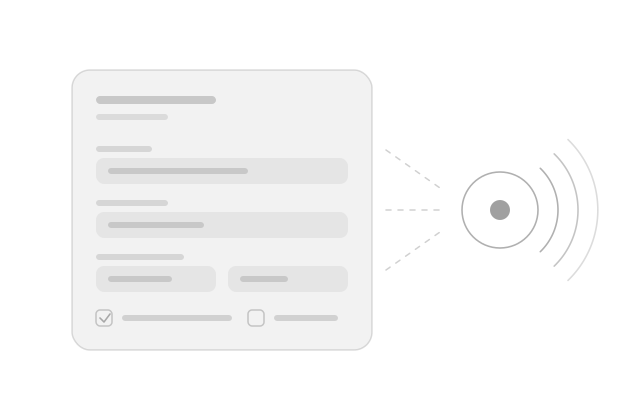
Name, contact details, the type of matter, the other parties involved, how urgent it is, and how they found you. Captured the same way on every call and sent to you as a record, not a voicemail.
Books the initial consultation
Reads your diary, offers slots you can actually honour, and confirms the appointment before the caller hangs up.
Answers questions about the firm
Areas of practice, office locations, opening hours, whether you offer fixed fees or a free initial call. From the material you upload, in your wording.
Screens what the firm doesn't take
You define which matters you act on. Anything outside that is declined politely and, if you want, pointed to a more suitable service, so a solicitor's callback is never wasted.
Transfers the genuinely urgent
Define what counts as urgent and where it goes. The agent warm-transfers to the duty solicitor or a nominated number with the caller's details already gathered.
Logged against the client record
Caller matched by phone number, with the call summary and outcome written back to your CRM as activity.
Why law firms lose enquiries
The calls a firm most wants are the ones it is least able to answer. A new matter arrives by phone, during working hours, from someone who has a problem now. The person who could take it is billing. Reception, if there is one, is dealing with the client at the front desk. The call rings out, and the caller, who typically has two or three firms open in another tab, rings the next one.
The economics make this expensive. A conveyancing instruction, a family matter, or an employment claim is worth hundreds or thousands of pounds in fees. That is why “law firm answering service” is one of the most expensive terms in UK paid search: the firms buying that click know exactly what a missed first call costs. An answering service, human or AI, exists to turn that missed call into a callback with enough information to act on.
What an agent can capture without giving advice
The line every firm needs to draw is the same one the SRA draws: the agent can tell a caller about the firm, and it can gather information from them, but it cannot advise. In practice that line leaves a great deal on the agent’s side of it.
What the agent handles:
- Who is calling, how to reach them, and how they found you
- What the matter is, in your categories, and roughly what stage it’s at
- The other parties involved, so a conflict check can run before anyone calls back
- How urgent it is, and whether it needs the duty solicitor now
- Whether the firm takes this kind of work at all
- Booking the initial consultation into a real diary slot
What it does not handle: anything that starts “should I” or “can they”. Those questions become a message for a solicitor, or a transfer. The agent will say it can’t advise, and it will say so every time, because the rule is enforced by the platform rather than by the prompt.
Where firms tend to start
Out-of-hours is the easy case. Nobody is currently answering those calls, so the agent is competing with voicemail rather than with a receptionist, and the comparison flatters it. Criminal and family practices in particular find that the calls arriving after 6pm are disproportionately the urgent ones, and that a structured intake with an urgency flag is a better Monday morning than a voicemail list.
Daytime overflow follows once you have read a week of transcripts. The agent picks up when reception doesn’t within a set number of rings, so the front desk keeps the calls it can take and stops losing the ones it can’t.
What to check before you commit
The questions your COLP will ask, and which any supplier should answer without hedging:
- Where is the call data processed and stored? Both, not just stored. Client information leaving the UK and EU is a conversation you don’t need to have.
- Is the audio retained? If it is, the firm has taken on a store of client voices with a retention policy someone has to own.
- How long do transcripts live, and can you delete one caller’s? “Indefinitely” and “not without deleting everything” are both real answers you will get.
- What stops it giving advice? If the answer is “the prompt tells it not to”, ask what happens when the prompt is edited. The guardrail should sit outside anything a user can change.
Compliance
Built for GDPR,not retrofitted to them.
The constraints that make voice AI awkward in regulated markets were designed in from the start.
- Processed and stored in Europe
- Calls, transcripts, and summaries stay in Europe. AI models are also based there and have zero data retention policies.
- Audio is never stored
- Speech is transcribed as the call happens and discarded.
- Everything a caller said expires
- Transcripts, caller numbers, and messages are deleted automatically 90 days after the call. Not a setting you have to remember.
- Erase customer data
- If a caller asks to be forgotten, you can erase every trace of them from the dashboard.
Frequently asked questions
Will it give legal advice?
No. The agent is constrained to information about the firm: what you do, where you are, how to instruct you, and when you're available. Anything that needs a solicitor's judgement is escalated to a human or captured as a message with a callback number. This is a platform guardrail, not a prompt instruction that could be overridden by accident.
Can it run a conflict check?
It captures what the check needs: the caller's details and the names of the other parties. It does not access your conflicts register or your case management system, and it never tells a caller whether you can act. Your team runs the check before the callback, with the information already to hand.
Is this compatible with client confidentiality and legal professional privilege?
Call data is processed and stored in the EU (Ireland), call audio is never recorded, and transcripts, caller numbers and messages are deleted automatically 90 days after the call. You remain the data controller and we act as processor. Discuss it with your COLP and DPO before rolling out, as you would with any new supplier handling client information.
Do we have to tell callers they're speaking to an AI?
No UK law requires it, but we'd recommend it and the default greeting says so. You write the greeting and it's spoken word for word, so the firm decides exactly how it introduces itself.
Does it work with our case management system?
Calls are written back to your CRM as contact activity with the caller matched by phone number, and every intake is sent to you by email. Tell us which case management system you use when you sign up; integrations are prioritised by what firms ask for.
Which areas of law does it cover?
Any. The agent knows what your firm does because you tell it, and it captures the matter type in your categories. Conveyancing, family, employment, private client, criminal, litigation and commercial firms all use the same intake tools with different configuration.
Hear it answeryour phone.
Set up an agent, try it in your browser, and put it on a real number.